Cartography of Stillness
Mapping landscape as memory, geological time, and emotional geography
An ongoing body of work exploring the unseen forces that shape land, place, and perception
Overview
Cartography of Stillness is an ongoing series of works that explores landscape as more than a physical environment. Instead, it considers land as a record of time, memory, and transformation.
These works are not intended to document specific places. Rather, they explore imagined landscapes shaped by geological processes, emotional responses, and the slow accumulation of time.
Mapping Beyond Geography
Cartography is traditionally concerned with mapping physical space, roads, borders, and locations.
In this series, cartography becomes something more fluid. It becomes a way of mapping relationships, memory, and the invisible structures that shape how we experience the world.
These works are not maps of where we are, but reflections on how we relate to place.
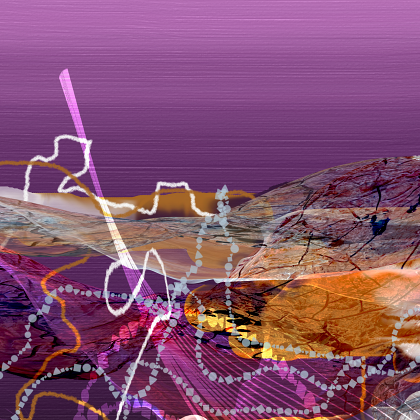
Landscape as Geological Memory
Although landscapes may appear still, they are constantly in motion over time.
Rivers carve valleys. Coastlines shift. Volcanic activity reshapes landforms. Erosion gradually rewrites what once seemed permanent.
These processes occur over vast timescales, yet their evidence is always present within the land itself.
This series responds to that idea—treating landscape as a layered record of change, rather than a fixed image.
Personal Perspective
My connection to landscape is deeply shaped by growing up in New Zealand, where geological forms, coastlines, and natural forces are ever-present in daily life.
I have also spent time living in Australia at different points in my life, which has further influenced my perspective on land and environment.
A quiet thread that has followed me since childhood is a fascination with volcanoes and archaeology. Volcanoes represent transformation and creation, while archaeology reveals what is hidden beneath the surface. Both continue to influence how I think about layered space, time, and memory within my work.
As someone with whakapapa Māori, I am also mindful of Te Ao Māori perspectives that understand people and land as interconnected rather than separate. This influences how I approach landscape, not as something to observe from a distance, but as something we are part of.
Process and Making
These works are created using digital painting techniques combined with traditional principles of composition, colour, and texture.
The digital process allows for layering, adjustment, and experimentation, building depth through accumulation, removal, and revision.
Each piece develops gradually, echoing the layered nature of geological time itself.
The intention is not to replicate specific landscapes, but to construct visual environments that feel both familiar and undefined.
Colour as Emotional Landscape
Colour in this series is not used to describe place literally, but to evoke atmosphere, memory, and feeling.
Earth tones suggest geological depth and erosion. Blues and greens evoke water, distance, and atmosphere. Brighter tones introduce moments of energy, transition, or tension.
Each work develops its own visual rhythm through these interactions.
An Ongoing Series
Cartography of Stillness is not a completed project.
It continues to evolve as new works are created and new ideas emerge around landscape, memory, and transformation.
Each piece adds to an expanding conversation about how we experience place, not as something static, but as something constantly unfolding.
Closing Reflection
Rather than offering fixed interpretations, this series invites reflection.
What lies beneath the surface of the landscapes we see?
How does place shape memory?
And how do we, in turn, shape our understanding of place?